Two Faiths, One Wedding: The Real Guide to Blending T&T's Multicultural Wedding Traditions
Catholic, Hindu, Anglican, Orisha — welcome to the most Trinidadian wedding problem there is. Here is how to make an interfaith ceremony work.
You are Catholic. She is Hindu. His mother is Anglican, and her grandmother is Orisha. And somehow, by the time the reception starts, you need all of them to feel like this wedding honours them.
Welcome to the most Trinidadian wedding problem there is.
In a country where roughly 35% of the population is Hindu, 21% is Roman Catholic, 18% is Protestant, 5% is Muslim, and Orisha and Spiritual Baptist traditions run deep in families who have been here for generations, the "interfaith wedding" is not a niche category — it is the norm wearing a different name. Roughly one in three T&T marriages involves partners from different religious backgrounds, and for couples planning a 2026 wedding, that number has only climbed.
The problem? The existing advice — from international wedding blogs, from Pinterest, from your cousin who had a "fusion wedding" in 2019 — is shallow. It tells you to "blend traditions" without explaining how to actually make a Saptapadi work in the same afternoon as a Catholic Mass. It does not tell you what happens when the Pandit's muhurat falls at 7 AM and the church will not do ceremonies before 10 AM. It does not warn you that your Imam and your mother's Orisha elder might have very different ideas about what "blessing the union" looks like.
This guide is the one we wish existed when we started talking to real T&T couples about how they actually pull this off. We spoke with planners, Pandits, pastors, and couples who have done it — and here is the unfiltered truth about blending T&T's wedding traditions without losing your mind, your budget, or your family's blessing.
The Rituals You Will Actually Use — and How to Sequence Them
Every interfaith wedding in T&T starts with the same question: what goes first, and what goes second? The answer depends on which traditions you are blending, but there are patterns that work.
Hindu + Catholic (the most common interfaith pairing in T&T)
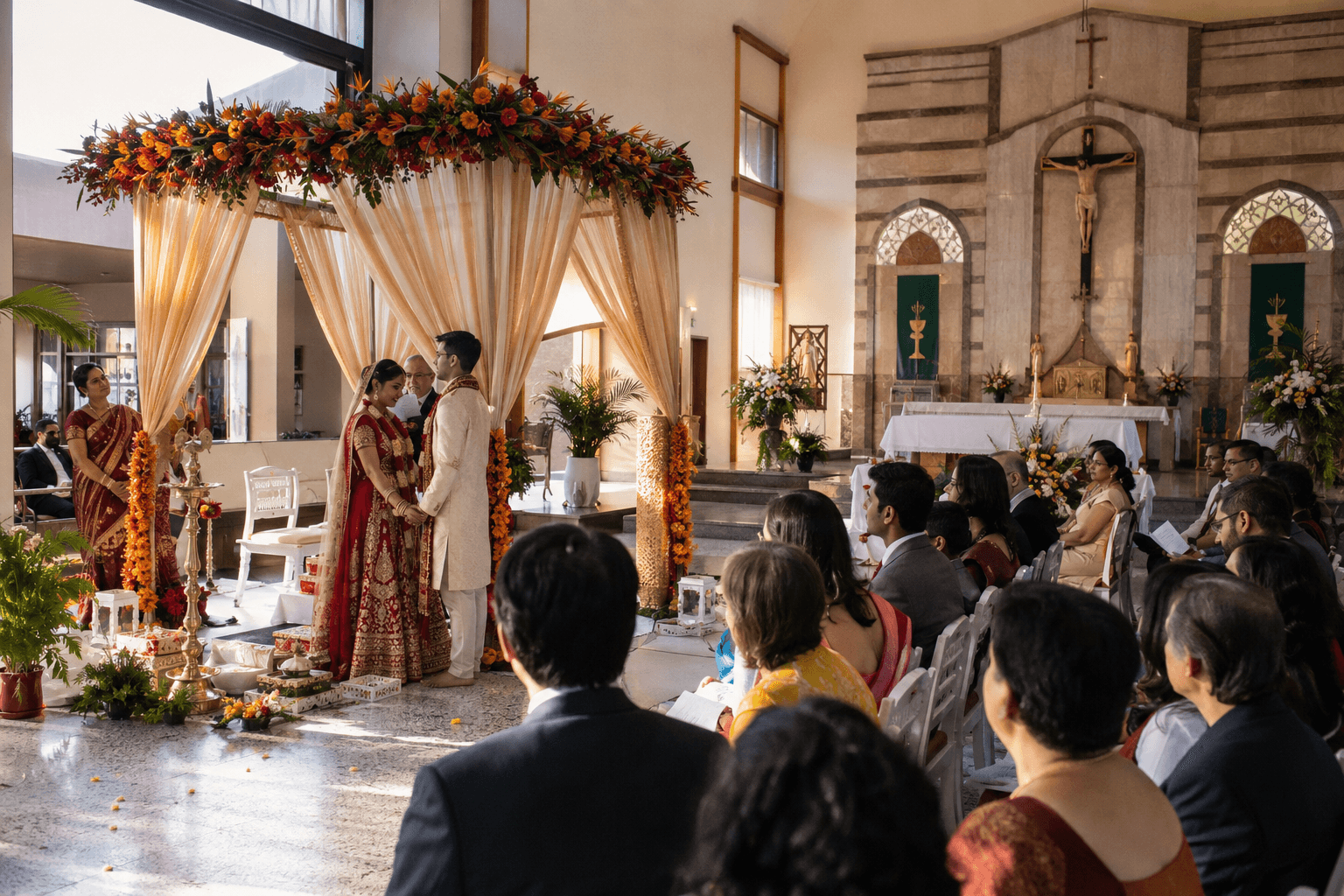
The formula that works for most couples: Catholic Mass in the morning, Hindu ceremony in the afternoon, secular reception at night. Or reversed, if the muhurat dictates it.
The Catholic side: You will need to complete a marriage preparation course (mandatory for the sacrament at most parishes — budget 8-12 weeks before the wedding). The church requires at least one reading from Scripture and the exchange of vows and rings. Some progressive Port of Spain parishes — like St. Theresa's in Woodbrook or the Cathedral of the Immaculate Conception in downtown POS — have experience with interfaith ceremonies. Some may allow a Pandit to offer a blessing in the church vestibule after Mass, though most draw the line at non-Catholic clergy speaking inside the sanctuary. Church donation: TTD 1,000–3,000. Marriage prep course: TTD 300–800.
The Hindu side: This is where timing gets tricky. The muhurat — the auspicious window calculated by your Pandit using the Panchang (traditional Hindu calendar) — is non-negotiable. If it falls at 6:47 AM, your wedding party needs to be ready at 5:30 AM. If it falls at 3:15 PM, you are doing Pheras in the middle of what should be cocktail hour.
What successful couples do: Book the muhurat first. Then build everything else around it. The church will usually be more flexible on timing than the Pandit — Catholic ceremonies can be scheduled at various times, but the muhurat is astronomically fixed.
The key rituals you keep from the Hindu side:
✓ Jaimala (garland exchange) — The bride and groom exchange flower garlands. The bride's family lifts her up so she can "win" by placing her garland higher. Playful, photogenic, takes 10 minutes. A perfect opener even for a shortened ceremony.
✓ Mangalsutra (sacred necklace) — The groom ties a black-and-gold beaded necklace around the bride's neck in three knots. This is the Hindu equivalent of "I now pronounce you." In an interfaith ceremony, this can follow the Catholic vows so both sides have their sealing moment.
✓ Saptapadi (seven steps around the sacred fire) — Seven vows, seven steps, around the Agni. Full form takes 30–45 minutes. For interfaith couples, a shortened 3-step version is becoming common in T&T — ask your Pandit about this specifically. The Sanatan Dharma Maha Sabha has issued guidance that shorter versions are acceptable for interfaith contexts.
Key rituals you keep from the Catholic side:
✓ Exchange of consent (vows) — the non-negotiable core. Keep it. ✓ Blessing of the rings — some couples incorporate the mangalsutra tying immediately after as a single continuous "exchange of symbols" moment. ✓ A reading from Scripture — can be done by a family member from either side.
Hindu ceremony cost breakdown (2026 TTD):
Mandap setup and decor — TTD 3,500 budget / TTD 8,000 mid-range / TTD 15,000 premium
Pundit fee and honorarium — TTD 1,000 / TTD 2,000 / TTD 3,000
Jaimala garlands (bride and groom) — TTD 400 / TTD 800 / TTD 1,500
Mangalsutra (gold and black beads) — TTD 800 / TTD 2,500 / TTD 5,000+
Bridal lehenga or Kanjivaram silk sari — TTD 5,000 / TTD 8,000 / TTD 15,000+
Groom sherwani (rental or purchase) — TTD 1,500 / TTD 3,000 / TTD 6,000+
Catholic ceremony cost breakdown (2026 TTD):
Church donation or booking fee — TTD 1,000–3,000
Marriage preparation course — TTD 300–800
Church decorations (pew bows, altar flowers) — TTD 3,000–8,000
Organist or cantor — TTD 800–2,000
Program printing — TTD 500–1,500
Pro tip: Many Catholic churches in T&T — especially older parishes like Holy Rosary in POS and St. Joseph's in San Fernando — do not charge a "booking fee" per se but expect a donation. Ask upfront what the expectation is.
Muslim + Christian: The Growing Interfaith Frontier
Muslim weddings centre on the Nikah — the marriage contract signing — and everything else flows around it. The key non-negotiables:
- Mahr (bridal gift): Mandatory. A gift from groom to bride agreed upon before the Nikah. Cash mahr in T&T typically ranges from TTD 2,000 to TTD 10,000+. Discuss this openly and early.
- Imam availability: Most Imams in T&T serve specific communities (ASJA, Tackveeyatul, Trinidad Muslim League). Book them 3–6 months in advance, especially for interfaith ceremonies where the Imam may need extra time to understand the situation.
- Halal catering: Non-negotiable if Muslim family members or the Imam attend the reception. A common interfaith compromise: the Nikah and a separate Muslim-family reception are halal, while the main evening reception has a mixed bar and non-halal options for non-Muslim guests.
The interfaith compromise that works: Do the Nikah as a private family ceremony (bride, groom, witnesses, Imam, immediate family — 20–30 minutes). Then do a larger public ceremony incorporating both traditions. This avoids putting the Imam in a position where he must bless a ceremony with non-Muslim elements.
Muslim ceremony costs (2026 TTD):
Imam or Qazi fee — TTD 1,000–3,000
Venue for Nikah (mosque hall or home) — TTD 0–2,000
Mahr (bridal gift) — TTD 2,000–10,000+
Walima reception (catering per head) — TTD 180–350
A note about Chaguanas and environs: this is the heartland of both the Hindu and Muslim communities in T&T. Vendors here — from caterers who do halal and vegetarian to mandap decorators who understand mosque-adjacent aesthetics — are some of the most experienced in the country with interfaith work. Do not overlook caterers and decorators in Charlieville, Felicity, and Endeavour.
Christian + Orisha: The Tradition Nobody Talks About
This is the interfaith pairing that gets the least coverage but is genuinely growing in T&T, especially among Afro-Trinidadian couples who want to reconnect with ancestral traditions while maintaining a Christian framework.
Orisha — also called Shango — is a syncretic faith blending Yoruba spirituality with elements of Catholicism and Spiritual Baptism. Roughly 0.9% of T&T identifies as Orisha, but the number of couples incorporating Orisha elements into Christian weddings is far higher.
What this looks like in practice:
- The palais: An Orisha ceremony space, typically outdoors, with a central pole or perogun (sacred shrine). Some couples have the palais set up in a family yard or rented country venue for a blessing ceremony before the main event.
- Flag planting: Coloured flags representing specific Orishas (red and white for Shango, yellow for Oshun) are planted at the ceremony site. Visual, powerful, and easily incorporated even in abbreviated form.
- Drumming and call-and-response: Unlike a Catholic or Anglican ceremony where music is performed for the couple, Orisha music is participatory — the community drums, sings, and dances. Couples blending Christian and Orisha often have a drumming circle during cocktail hour or as the wedding party processes out.
What couples get wrong: Thinking you can just "add" Orisha elements without community protocol. Orisha is a living religion with elders — you need permission and guidance from a legitimate babalawo (priest) or iyalorisha (priestess). Your wedding decorator cannot DIY an Orisha blessing. Reach out to organisations like the Ojubo Orisa Omolu or the Orisha Council of T&T for guidance.
The Anglican connection: Many Orisha-practising families in T&T also identify as Spiritual Baptist or Anglican. The Anglican Church — particularly St. Mary's in POS, All Saints in San Fernando, and St. Patrick's in Newtown — has been historically accommodating of cultural expressions within the church framework. Some Anglican priests will allow drumming, flag planting, or Orisha prayers on church grounds as long as they do not contradict Anglican doctrine. Ask before assuming.
The Venues That Actually Do Multicultural
You cannot assume any venue knows how to handle a Hindu fire ceremony followed by a Catholic blessing. You need a venue whose team has done this before.
Port of Spain hotel ballrooms that work:
- The Hyatt Regency Trinidad — handles mixed-faith events regularly. Dedicated wedding coordinator who can manage complex timelines. Ballroom capacity: 150–400. Room hire: TTD 25,000–60,000.
- The Kapok Hotel and Carlton Savannah near the Queen's Park Savannah — both have hosted interfaith weddings and are familiar with multi-religious timeline management.
Dedicated event venues with interfaith experience:
- La Belle Vie Wedding and Event Centre (Cunupia) — has hosted Hindu, Christian, and fusion weddings. Dedicated mandap-ready space. TTD 10,000–18,000 for venue hire.
- The Venue at Angel's Valley (St. Augustine) — known for accommodating multi-faith weddings. Can set up both a mandap and an altar in separate areas of the grounds.
- Brix at Cameron Hills (Crown Point, Tobago) — experienced with mixed religious traditions for Tobago destination interfaith weddings.
Churches that accommodate interfaith blessings:
- All Saints Anglican Church (San Fernando) — progressive and community-oriented.
- St. Mary's Anglican Church (Port of Spain) — historically inclusive.
- St. Theresa's Roman Catholic Church (Woodbrook, POS) — familiar with mixed-faith couples, though still bound by Catholic rules.
The wild card: family property. Many interfaith couples in T&T end up at a family home or land because it offers the most flexibility — no church rules, no mosque restrictions, no venue policies. Budget TTD 7,000–18,000 for tent, portable toilets, generator, and police permit if you go this route.
The Three Big Mistakes Interfaith Couples Make
We asked T&T wedding planners, clergy, and couples who have done it what they would do differently. These three themes came up again and again.
Mistake 1: Not getting the religious leaders in a room together before the wedding
This is the number one regret. Couples assume the Pandit, the priest, and the Imam will each do their part and it will all work out. But religious leaders have egos, theological boundaries, and practical requirements. A Pundit will not conduct Saptapadi in a church. A priest will not bless a marriage in a mandap. An Imam will not recite the Nikah if alcohol is being served nearby.
The fix: 4–5 months before your wedding, arrange a meeting (in person or on WhatsApp) with ALL religious leaders who will officiate. Explain the timeline. Ask each one: "What is your absolute line in the sand?" and "What element from the other tradition are you comfortable blessing?" The couples who do this rarely have ceremony-day drama. The ones who skip it find out at 3 PM on Saturday that the Pandit will not enter the church vestibule.
Mistake 2: Trying to do everything in one ceremony
The most successful interfaith couples in T&T understand something the struggling ones do not: the ceremony and the blessing can be separate.
- Morning: Catholic Mass at a church (with the priest's knowledge that a Hindu ceremony will follow).
- Afternoon: Hindu Pheras at the reception venue (the Pandit takes over from here).
- Evening: Secular reception with toasts, cake, and soca.
Or:
- Private Nikah at home with immediate family and the Imam (Friday evening).
- Public Christian ceremony at church (Saturday morning).
- Unified reception (Saturday evening, halal catering, no alcohol for the first hour).
Each tradition gets its full expression without being watered down. Guests from both sides feel respected. Nobody sits through a ceremony that makes them uncomfortable.
Mistake 3: Assuming the budget works the same as a single-faith wedding
A wedding combining two religious traditions has roughly 1.5 times the ceremony costs of a single-faith wedding. You are paying for:
✓ Two sets of ritual items (mandap flowers + church altar flowers)
✓ Two religious leader honorariums (Pundit + priest / Imam + pastor)
✓ Potentially two attire sets (bridal lehenga + white gown)
✓ Extra venue and coordination time (dual ceremonies = longer hire)
The couples who budget for this upfront are fine. The ones who assume they can "just add a Pandit blessing" for free are the ones calling their wedding coordinator in tears two weeks out.
The T&T Reception: Where All Traditions Collide in the Best Way
Here is the thing about T&T wedding receptions: the ceremony is where the families negotiate their differences, but the reception is where they become one people. Trinidadians know how to party together, regardless of faith.
The elements that cross every tradition:
✓ Jumping the broom — This West African tradition, carried through slavery and embedded in Caribbean wedding culture, has made a strong comeback in T&T, particularly among Afro-Trinidadian couples and couples blending African heritage with Christian or Orisha traditions. The couple jumps over a broom decorated with ribbons and flowers at the end of the ceremony or start of the reception. In T&T, some couples have the broom decorated by an Orisha elder or Spiritual Baptist leader. Cost: TTD 200–800 from local artisans in Port of Spain and San Fernando.
✓ The dollar wine or money dance — A staple of T&T weddings across every faith. Guests pin money on the couple (or the bride's dress, or a designated doll or chalice) in exchange for a dance. Expect aunties pinning TT$100 notes all over the groom's sherwani or tuxedo. Some couples fund their entire honeymoon this way — expect to raise TTD 5,000–20,000 depending on your guest list.
✓ Black cake push — Every T&T reception has a moment where the bride and groom "push" the first slice of black cake into each other's faces. The cake itself (rum-soaked fruit cake) is a T&T cultural hybrid — British origins, African fruit preservation techniques, Caribbean sugar plantation fermentation. Cost: TTD 3,000–8,000 for a custom cake from a T&T baker.
✓ Bouquet toss — the T&T version — In T&T, the bouquet toss often doubles as a "who's next" moment where the man who catches the garter often has to do a lap dance or "wine" with the woman who caught the bouquet. If you are a conservative interfaith couple, skip this or replace it with a ribbon pull (multiple ribbons attached to the bouquet, only one connected — each single woman pulls, the one who gets the actual bouquet wins).
✓ The chair game — The bride sits on a chair, the groom kneels before her, and they are asked questions like "Who said I love you first?" and "Who is the better driver?" Each holds one shoe — the bride's and the groom's — and raises the appropriate shoe to answer. Cheap, hilarious, requires zero setup.
The 12-hour soca set: Not a game, but a necessity. Your DJ needs to know that at a T&T reception, you cannot play slow songs for more than 20 consecutive minutes without losing the room. A good T&T wedding DJ mixes soca, chutney soca, parang (if it is December), and at least one classic Destra or Machel tune. Budget TTD 5,000–10,000 for a DJ who truly understands the T&T wedding floor.
2025–2026 Trends: What T&T Interfaith Couples Are Doing Differently
We asked planners and vendors what has changed in the last year. Here is what they are seeing:
The Saturday-only mandate is fading. Because interfaith ceremonies often require more time, more couples are programming weddings across two or three days. Friday evening: Nikah or private family ceremony. Saturday: main ceremony and reception. Sunday: Orisha thanksgiving or Spiritual Baptist "thanksgiving service." This spreads the cost and allows each tradition its own space.
The "Registrar General first" strategy. More couples are doing a civil ceremony at the Registrar General Department on Abercrombie Street, Port of Spain first — just the legal minimum, a simple 15-minute affair with two witnesses. Then the religious ceremonies become symbolic, taking all the legal pressure off the Pandit, priest, or Imam. Cost: TTD 40–100 for the marriage license; the appointment is free but you need to book weeks in advance. This is the single most practical strategy we heard from planners.
Shortened Saptapadi is now standard for interfaith couples. Most T&T Pandits now offer a 3-step version of the seven steps for couples blending traditions. Ask specifically for "the shortened pheras" — not all Pandits offer it, but the Sanatan Dharma Maha Sabha has issued guidance that shorter versions are acceptable for interfaith contexts.
Own the timeline, do not hide it. The most successful couples in 2025–2026 are the ones who put the interfaith nature of their wedding front and centre. Wedding programs that explicitly explain each ritual — "The Saptapadi: seven vows around the sacred fire, representing… The Exchange of Consent: the Catholic vows where the couple declares…" — help guests from both sides understand and appreciate what they are witnessing. Couples who try to "smooth over" the differences by being vague end up with confused guests who do not know when to stand, sit, or take photos.
The Orisha revival is real. Among younger Afro-Trinidadian couples, particularly those aged 25–35, there is a growing movement to reincorporate Orisha elements into weddings that otherwise follow Christian or secular structures. A babalawo consultation, a flag-planting ceremony, or an Orisha prayer from an elder is becoming as common as jumping the broom. This is happening especially in communities in east Port of Spain, Laventille, and parts of south Trinidad.
The Bottom Line: What This Actually Costs
If you are blending two traditions in one T&T wedding (2026 pricing):
2-traditions interfaith ceremony premium — TTD 12,000–45,000
3-traditions interfaith ceremony premium — TTD 16,000–60,000
Single tradition ceremony (reference) — Baseline
This premium covers the extra religious leader fees, dual ceremony decor setups, potentially two attire looks, extra venue hours, and coordination complexity. This is on top of your standard reception costs (catering, venue, photography, DJ, cake, florals).
The premium exists. But couples who budget for it do not panic about it. The ones who do not see it coming? They are the ones you hear about at lime, saying their wedding "cost way more than they planned" — which in T&T wedding language usually means they did not account for the fact that they were planning two weddings in one.
Planning an interfaith ceremony and need help finding the right vendors? IslandTulle is building the first T&T marketplace where you can filter vendors by interfaith experience.
Planning your Caribbean wedding?
IslandTulle is launching soon — the Caribbean's first dedicated wedding marketplace for T&T couples. Join the waitlist for first access.